 11
11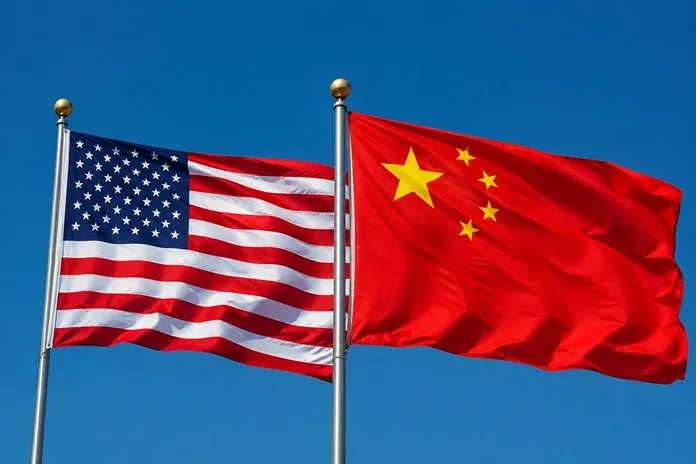
As President Donald Trump prepares to meet Chinese President Xi Jinping in Beijing for a high-stakes summit, the balance of power between the world’s two largest economies is once again under scrutiny.
The meeting comes at a time of intensifying rivalry between Washington and Beijing, with competition spanning trade, technology, military strength and geopolitical influence. Analysts say the outcome of the summit could shape the global order for decades.
The relationship between the two powers has become increasingly strained during Trump’s presidency, particularly over trade. Trump launched a tariff-driven trade war during his first term in office, targeting what he described as an unfair trade imbalance with China. Tariffs escalated further during his second term, including sweeping measures introduced on what he called “Liberation Day.”
China responded with retaliatory tariffs of its own, at one stage pushing rates above 125 percent. Although tariff levels have since eased on both sides, the dispute exposed vulnerabilities in both economies.
The United States has faced rising costs and political pressure over inflation, while China’s export-driven economy has also felt strain. Beijing continues to grapple with debt concerns, a weak property sector, deflation and high youth unemployment.
Despite those challenges, China has sought to project resilience. Beijing has increasingly turned to alternative markets while leveraging its dominance in rare earth elements — materials critical to products ranging from smartphones and electric vehicles to artificial intelligence systems and advanced weapons technology.
Observers say China’s control of the rare earth industry gave it substantial leverage during the trade standoff, particularly as Washington attempted to reduce dependence on Chinese manufacturing after decades of outsourcing.
Public attitudes toward the two leaders also reflect the rivalry. Chinese social media users have circulated a phrase loosely translating to “Trump nation builder,” suggesting Trump’s policies have inadvertently strengthened China’s international standing.
In the United States, however, awareness of Xi among ordinary Americans appeared mixed, with some people interviewed unable to identify the Chinese leader by name.
Beyond trade, the summit takes place amid broader questions over global leadership. Trump has challenged long-standing US alliances, including criticism of NATO and controversial remarks about Greenland, while promoting a more nationalist foreign policy sometimes described as the “Donroe Doctrine,” aimed at reinforcing American dominance in the Western Hemisphere and countering Chinese influence.
Meanwhile, Beijing has sought to portray itself as a stable and reliable international partner. China has expanded investment across the Global South and cultivated relationships with nations that feel marginalized by Western powers. Chinese officials have increasingly presented the country as a predictable alternative to what they characterize as Western instability.
The historic backdrop of the upcoming summit also carries symbolic weight. In 1972, President Richard Nixon visited Shanghai and signed the Shanghai Communiqué with then-Chinese Premier Zhou Enlai, laying the foundation for modern US-China relations after years of isolation.
Military power remains another major point of comparison between the superpowers. The United States still possesses the world’s most experienced military force, though recent conflicts and diplomatic struggles — including tensions involving Iran and shipping through the Strait of Hormuz — have raised questions about Washington’s strategic effectiveness.
China, by contrast, has rapidly modernized its armed forces and invested billions into military expansion. While its military may now be among the largest in the world, analysts note that the modern People’s Liberation Army has not officially fought a major war in decades.
Taiwan continues to represent perhaps the most dangerous flashpoint between the two countries. Beijing has repeatedly vowed to reunify the self-governing island with mainland China, by force if necessary. Analysts say US intervention would likely be the greatest obstacle to any Chinese military action.
Trump’s position on Taiwan has drawn particular attention. While officially maintaining the long-standing US policy of “strategic ambiguity,” some of his public comments have created uncertainty over whether the United States would definitively defend Taiwan in the event of a Chinese attack.
The ideological divide between the two nations also remains stark. Chinese leaders argue that centralized Communist Party control has delivered stability and national success, while portraying democracy as chaotic and divisive. Xi, unlike Trump, does not face electoral pressure and is widely viewed as pursuing a long-term strategic agenda.
Despite deep disagreements, both leaders have publicly emphasized the importance of stability in the relationship. Trump has repeatedly described ties with Xi as “excellent” and “very good,” while Beijing has signaled what observers describe as a pragmatic partnership driven by mutual necessity.
As Trump arrives in Beijing, the summit is being viewed not only as a test of personal diplomacy between two powerful leaders, but also as a defining moment in the struggle for global influence between the United States and China.